What Is KYC? Verification Explained for Crypto and Fintech (2026 Guide)


You open an account on a major crypto exchange, fund it with stablecoins, make a few profitable trades, and head to the withdrawal tab. Instead of the expected confirmation screen, a modal pops up: your withdrawal is locked until you upload a government ID and complete a live 3D facial scan.
KYC (Know Your Customer) is a mandatory identity verification process used by financial institutions, crypto exchanges, and fintech platforms to confirm the real-world identity of their users and prevent illicit activities like money laundering, fraud, and terrorism financing. Regulators require platforms to link every active financial account to an identifiable individual before granting access to fiat rails, higher withdrawal limits, or peer-to-peer (P2P) trading.
KYC vs. AML: What’s the Real Difference?
KYC answers “Who are you?”, while AML (Anti-Money Laundering) answers “Where did your money come from?”
KYC is a specific, upfront identity check conducted when you onboard or upgrade your account limits. AML, on the other hand, is an ongoing framework of automated surveillance, transaction monitoring, and risk assessment designed to spot suspicious patterns after your account is active.
The standard compliance workflow consists of three distinct stages:
- CIP (Customer Identification Program): The collection and automated validation of basic identifying information, such as your legal name, date of birth, residential address, and passport number.
- CDD (Customer Due Diligence): An automated background risk check. The platform runs your credentials against global sanctions databases, politically exposed person (PEP) watchlists, and adverse media archives to assign you a compliance risk score.
- EDD (Enhanced Due Diligence): An intensive manual review triggered if you trade seven-figure volumes, run a high-risk entity, or interact with high-risk blockchain nodes. This stage demands detailed tax returns, employment agreements, or corporate ownership registries.
The 3 Tiers of KYC Verification on Crypto Platforms
Tier-1 crypto platforms—such as Binance, Kraken, OKX, and Bybit—structure user privileges into escalating verification tiers. The more verifiable data you share, the higher your transaction and withdrawal limits.
- Tier 1 (Basic / Starter): Requires only a verified email address, phone number, and self-reported country of residence. In 2026, Tier 1 is largely an exploratory status: you can browse trading interfaces and make small crypto-to-crypto deposits, but fiat gateway access and withdrawals are either blocked or capped at negligible daily limits.
- Tier 2 (Standard / Intermediate): The baseline tier for regular traders. It requires a government-issued photo ID (international passport, national identity card, or driver’s license) combined with a biometric liveness selfie test. Unlocks complete P2P trading access, debit card deposits, and standard daily crypto withdrawal limits (often up to $50,000 or 100,000 USDT).
- Tier 3 (Advanced / Pro): Demands a verified Proof of Address (PoA) issued within the past 90 days, alongside documented source-of-wealth records for top brackets. Tier 3 unlocks high-volume institutional SEPA/SWIFT wire transfers, OTC desk execution, and daily withdrawal limits scaling past $1,000,000.
Verification Tiers at a Glance
| Tier Level | Required Documents | Processing Time | Average Daily Limits | Primary Use Case |
| Tier 1 (Basic) | Email, phone number, country declaration | Instant (under 60 sec) | Deposits only; withdrawals capped under $100 | Exploring the platform interface and low-value testing |
| Tier 2 (Standard) | Government-issued photo ID + biometric liveness scan | 5 to 15 minutes | $50,000 to $100,000 | Retail trading, P2P transactions, and everyday crypto withdrawals |
| Tier 3 (Advanced) | Utility bill / bank statement (under 90 days old) + PoW/PoS | 2 to 24 hours | $1,000,000+ or unlimited | Institutional trading, high-volume arbitrage, direct wire transfers |
How to Pass KYC on the First Try: A 5-Minute Checklist
Automated optical character recognition (OCR) algorithms handle the first review on almost every modern platform. If the image is blurry, unevenly lit, or misaligned, the algorithm automatically bounces your application to a manual review queue, delaying your access for days.
- Eliminate Glare and Reflections: Place your ID flat on a matte, dark surface under uniform, indirect natural daylight. The lamination on driver’s licenses and passports reflects direct overhead lights and flash photography, blinding the OCR scanner at the machine-readable zone (MRZ).
- Use Your Smartphone Camera, Not Your Desktop Webcam: Desktop webcams lack the macro focus needed to capture microprinting and holographic watermarks on government documents. Scan the on-screen QR code and finish the capture flow on your mobile phone.
- Match Latin Characters Exact to Your Passport: If your local ID includes special diacritics or non-Latin scripts, use an international passport instead. Type your legal first, middle, and last names exactly as formatted in the passport MRZ strip at the bottom of the data page.
- Generate an Official Digital Bank Statement (PoA): For address verification, skip utility bills altogether. Download a fresh, digitally generated monthly account statement directly from your mobile banking app. It must clearly display your full legal name, current residential address, institution logo, and an issuance date within the last 90 days.
Why KYC Gets Rejected: Common Pitfalls vs. Easy Fixes
Most failed identity checks stem from minor technical mistakes made during capture rather than fraudulent intent.
| Common Mistake | Why the System Rejects It | The Direct Fix |
| Cropped Document Edges | Automated scanners check the physical perimeter and borders of the ID to detect tampered, cropped, or glued card replicas. | Frame the ID with clear space around all four corners of the card or passport booklet visible against a dark background. |
| Active VPN During Liveness Checks | The platform’s fraud engine flags a geographic mismatch between your claimed residential IP, device telemetry, and data-center IP ranges. | Turn off commercial VPN tunnels and proxy servers on your device before launching the facial scanning sequence. |
| Uploading Web Screenshots | Digital platforms reject mobile or desktop screen captures of electronic PDFs because image metadata confirms they are second-generation copies. | Upload the original, unedited vector PDF downloaded directly from your bank or utility provider portal. |
| Obscuring the MRZ Strip | Thumbs, reflections, or low-light shadows across the bottom two lines of numbers and carets prevent automated database validation. | Keep your fingers completely outside the frame of the document while shooting the photo. |
Can You Bypass KYC or Buy “Pre-Verified” Accounts?
No tier-1 centralized exchange permits unverified fiat withdrawals, and buying pre-verified “drop” accounts is an easy way to lose your entire balance.
A cottage industry of shady Telegram channels and darknet forums sells exchange accounts registered to third-party individuals (often called “drops”). Using these accounts carries severe, unhedged operational hazards:
- Instant Reclamation by the Original Owner: The individual whose identity verified the account can contact customer support at any point, state their account was compromised, complete a rapid video identification check, and sweep every satoshi out of your balances.
- Sudden Re-KYC Account Locks: Centralized exchanges continuously run behavioral risk profiling. If your account shows an IP hop, a change in operating system parameters, or an unusual withdrawal volume, the security system automatically freezes withdrawals until the original owner completes a surprise live biometric face scan.
Running Multiple Verified Accounts: The Anti-Fraud Trap
Legitimate crypto operations often require managing multiple distinct accounts across exchanges. You might manage your personal trading portfolio, a corporate account for a registered LLC, separate client balances, or specialized setups tied to crypto airdrop farming across hundreds of wallets. Similarly, operations relying on virtual cards (VCC) for multi-accounting must maintain strict technical separation to prevent cross-account flags.
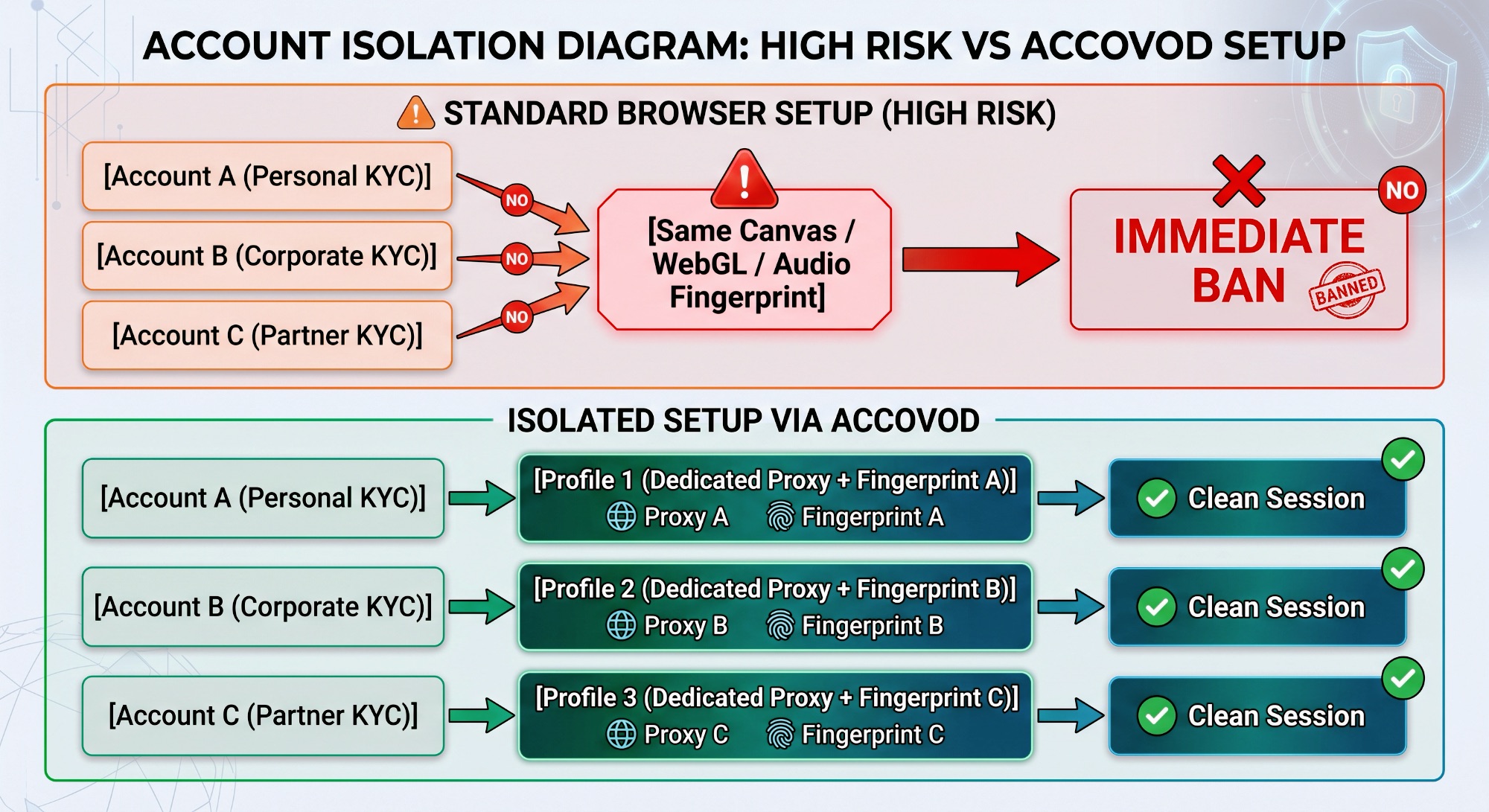
The trap: Even if every single account is backed by authentic, distinct legal documents, exchange anti-fraud systems track more than names.
They monitor your device fingerprint: Canvas API rendering, WebGL signatures, AudioContext characteristics, media device IDs, hardware concurrency, and local browser cookies. If two or three distinct KYC-verified accounts consistently share the exact same hardware fingerprint and residential IP address, exchange algorithms flag them as an illegal multi-accounting farm and freeze their balances.
The solution: You must run each account in an entirely isolated browser environment. An antidetect browser like Accovod creates distinct, persistent browser environments with independent fingerprints, isolated cache storage, and dedicated proxies. This setup ensures your legitimate verified profiles remain strictly isolated from one another, keeping your operational infrastructure stable and preventing false-positive security freezes.
Key Takeaways
KYC is a core regulatory requirement on every centralized exchange in crypto and fintech. For standard spot trading, basic P2P buying, and standard crypto transfers, completing Tier 2 verification with a clean passport and a five-minute biometric scan covers nearly all operational needs. If your business model involves managing multiple distinct, fully verified accounts across teams or corporate entities, pair real legal documentation with proper technical isolation so you never trigger exchange anti-fraud systems.
Frequently Asked Questions
Is it safe to upload my passport to crypto exchanges?
Tier-1 exchanges handle identity data via certified compliance processors like Sumsub, Jumio, or Onfido, which use end-to-end encryption and adhere to SOC 2 Type II and ISO 27001 data-security standards. To keep your information safe, verify that your exchange holds legitimate operating licenses, provides public proof-of-reserves, and features no history of private data compromises.
How long does KYC verification usually take?
Automated document validation and biometric liveness checks generally clear within 5 to 15 minutes. Delays stretching past 24 to 48 hours occur when low-resolution photos, glare, or mismatched spelling force your application out of the automated engine and into a manual review queue.
Can I withdraw crypto without KYC in 2026?
Major centralized exchanges (CEXs) enforce mandatory Tier 2 KYC for withdrawals. If you need to swap or move assets without submitting identity documents, you must use non-custodial decentralized exchanges (DEXs), cross-chain liquidity bridges, and self-hosted hardware wallets.
What should I do if my KYC verification fails repeatedly?
Review the rejection notice from the compliance team to see the exact reason, which is usually related to optical defects or document age. Disconnect all VPN connections, make sure the document has at least three months of remaining validity, confirm the name matches your application letter-for-letter, and re-run the biometric check using your smartphone camera under natural light.