Affiliate marketing for beginners: how to get started step by step
Affiliate marketing for beginners comes down to a few steps. You join a program, get a tracked link and share it where people already follow you. When someone buys or signs up through that link, you earn a commission. You don’t need a product of your own, and most programs are free to join.
Contents
- What is affiliate marketing?
- Who’s involved: merchants, networks and affiliates
- How affiliates get paid
- Free traffic or paid traffic
- Affiliate marketing for beginners, step by step
- Can you start affiliate marketing with no money?
- Why affiliates end up with multiple accounts
- How to run affiliate accounts in Accovod
- How to give a teammate access without sharing passwords
- FAQ
- What to remember
What is affiliate marketing?
Affiliate marketing is a way to earn money by recommending other companies’ products. The company gives you a link with your ID in it, and you put it in a blog post, a YouTube description, a TikTok bio or an ad. When someone clicks the link and buys, the company knows the sale came from you and pays you a commission.
For example, an online store pays 8% per order. You review a pair of headphones and add your link under the video. A viewer buys them for $150, and you earn $12. If the buyer sends the headphones back, the commission is usually reversed.
Tracking works through cookies. When someone clicks your link, the store saves your ID in their browser for a set time, anywhere from a day to a few months depending on the program. If they come back and buy within that window, the sale still counts as yours. That’s why the commission, the cookie window and the list of allowed traffic sources are the first things to check in any program’s terms.
Who’s involved: merchants, networks and affiliates
A typical affiliate deal involves a merchant, a network and an affiliate.
- The merchant, also called the advertiser or brand, sells the product. It can be an online store, a bank, a software company or a mobile game. Its deal for affiliates, with the payout and the rules, is called an offer.
- The affiliate network collects offers from many merchants in one dashboard. It tracks clicks and sales, checks traffic quality and pays you. CJ, Awin, Impact and ClickBank are well-known examples.
- The affiliate, sometimes called a publisher or partner, brings people to the offer through their link.
Many brands also run their own programs, Amazon Associates being the best known. In that case you work with the brand directly. For a first program, a network is often easier, because you get lots of offers, one set of stats and one payout in a single account.
How affiliates get paid
Every offer’s terms spell out the payout model.
| Model | What you’re paid for | Where it’s common |
|---|---|---|
| CPS (cost per sale) | A percentage or a fixed amount per paid order | Online stores, Amazon Associates |
| CPA (cost per action) | A set action, such as a purchase, a sign-up or a deposit | Most offers in “CPA networks” |
| CPL (cost per lead) | A form with the customer’s contact details | Insurance, finance, online courses |
| CPI (cost per install) | An app install | Mobile games and apps |
| RevShare | A share of what the customer pays, for as long as they stay | Subscriptions, betting, iGaming |
Commissions aren’t paid right away. The merchant first checks orders for returns, duplicates and fraud, and your money sits on hold until then. Payouts 30 to 60 days after the sale are common, and many programs also have a minimum payout.
In CPA networks, the share of leads the advertiser accepts is called the approval rate. A high payout with a low approval rate can earn you less than a medium payout with a high one, so look at both before you pick an offer.
Offers are grouped into verticals by topic. The usual ones are e-commerce, finance, software, education, dating, nutra (health and beauty products), iGaming, betting and crypto. iGaming, betting and crypto tend to pay more, but ad platforms restrict those ads heavily.
Free traffic or paid traffic
You can bring people to an offer in two ways. One is to build your own audience with a blog, a YouTube channel, social media pages or a newsletter. The other is to buy ads on Facebook, TikTok, Google or native ad networks and send that traffic to the offer. People who do the second are called media buyers, and the work is often called CPA marketing or affiliate media buying.
| Your own content | Paid ads | |
|---|---|---|
| Money to start | Close to zero | An ad budget |
| First results | Usually months | Days |
| What you risk | Your time | Your ad spend |
| Accounts you’ll run | A few pages, one per niche or language | Many ad accounts, often bought |
Without a budget, start with content. With one, paid traffic gives you answers faster, but you’ll need to compare spend and revenue every day.
Affiliate marketing for beginners, step by step
- Pick a niche you understand, such as fitness, gaming, tech, personal finance or travel. It’s easier to recommend products you’d buy yourself, and your audience can tell the difference.
- Choose one traffic channel. Without a budget, that’s TikTok, Instagram Reels, YouTube Shorts, Pinterest or a simple review site. With a budget, it’s Facebook, TikTok or Google ads. With one channel, you see much sooner what works and what doesn’t.
- Join a program and read the terms. Check which countries they accept, which traffic sources are allowed, the payout, the cookie window and the hold. Traffic from a source that isn’t allowed often doesn’t get paid.
- Set up separate work accounts. Keep business pages and ad accounts apart from your personal ones, and give each one its own browser profile. A ban on one work account then won’t spread to your personal profile or your other ad accounts.
- Start with a small test. For paid traffic, that’s a small budget across a few ads. For content, it’s a few weeks of regular posts. Watch clicks, conversions and earnings per click (EPC).
- Scale what works. Add new pages, ad accounts, countries and offers one at a time, so you know what made the difference.
By step 4 you already have a few accounts. Once you start scaling, you may have dozens.
Can you start affiliate marketing with no money?
Yes. Joining affiliate programs and networks is free, and you can get traffic from social media pages, YouTube or Pinterest without paying for ads. Many affiliates start this way, posting short videos or pins about products in one niche and linking to them from their bio or description.
The costs show up later. You’ll pay for a domain and hosting if you build a site, for ads if you move to paid traffic, and for proxies and tools once you run several accounts.
You can also start from your phone, since social apps and most affiliate dashboards work there. If you keep several accounts, the Accovod app for iPhone and iPad opens the same cloud profiles you use on your computer, with the same proxies.
Why affiliates end up with multiple accounts
Almost every affiliate ends up running several accounts, usually for the same reasons.
- Media buyers run several ad accounts on Facebook, TikTok and Google for different offers and countries, plus backups in case one gets banned. Many of them are bought, and we covered what to check before you pay in our guide to buying Facebook accounts.
- One TikTok or Instagram page per niche or language usually grows faster than one page about everything.
- To see an offer and its ads the way a local sees them, you need an IP from that country.
- In a team, a media buyer runs the ads, someone else prepares and warms up accounts, and the owner checks the stats, all in the same accounts.
Platforms watch for people who come back with new accounts after a ban. When all your ad accounts log in from one IP and one browser, the platform can link them, and a ban on one can take down the rest. Accounts get linked by a shared IP, by shared cookies and browser storage, and by a matching browser fingerprint, which includes your screen, graphics card, fonts, language and time zone.
So each work account needs its own browser profile with its own cookies, proxy and fingerprint. We go through the other ways to run several accounts in our guide on how to manage multiple social media accounts.
How to run affiliate accounts in Accovod
Accovod is our browser for people who run lots of accounts. It works on Windows and Mac, and cloud profiles also open on iPhone and iPad. Every profile has its own cookies, proxy and fingerprint, and its language and time zone follow the proxy’s country. Most antidetect browsers open each profile in a separate window. In Accovod, all profiles sit in one list in one window, and you switch between ad accounts in one click, like tabs.
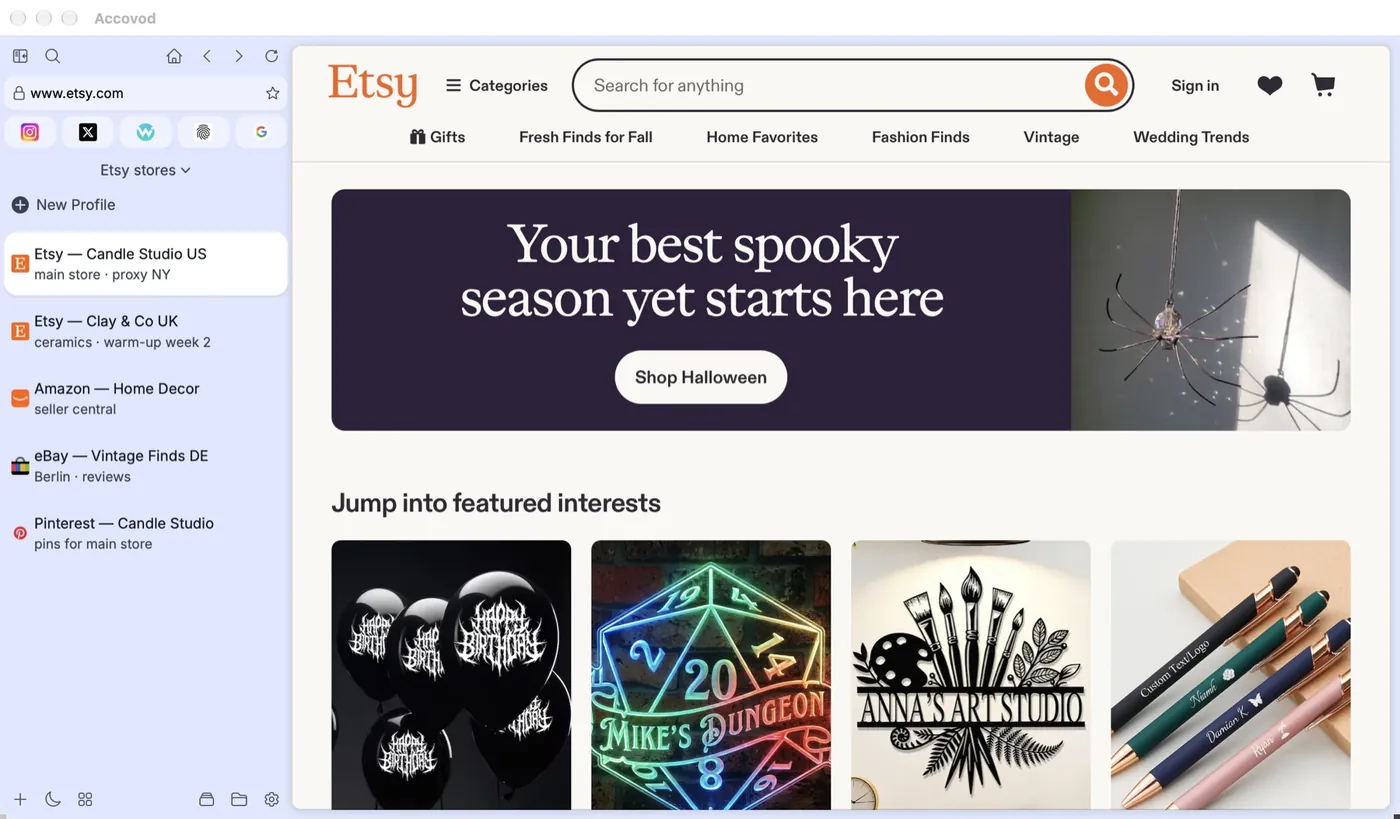
To add a work account:
- Click New Profile. Type the site in Platform, such as facebook.com or tiktok.com, and the account name in Account. The note is a good place for the offer, the country or the warm-up day.
- Paste a proxy from the country you need (HTTP or SOCKS5) and click the check mark. Accovod tests the proxy and shows the IP, the country and the Fraud Score.
- Click Add and log in. A bought account, or one from another antidetect browser, can be moved with cookies in JSON format, so you won’t need the password or an SMS code.
- If the account is new, tick Run Walker. Walker warms up new accounts while you get your ads ready.
- Sort the profiles into groups by offer, country or client.
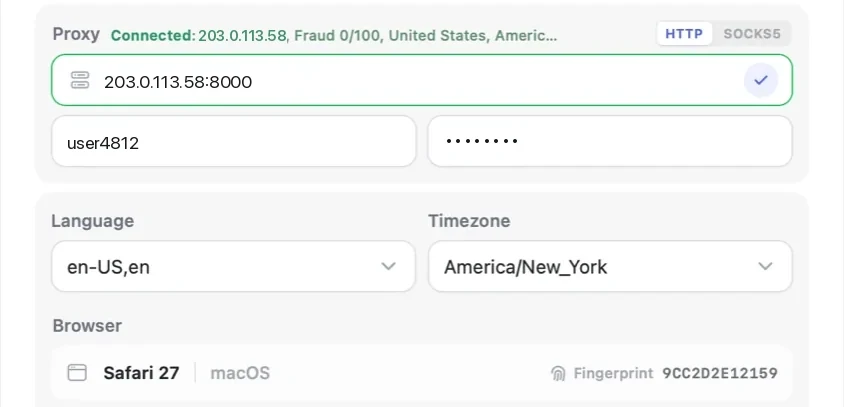
If you’re not sure how to enter a proxy with a username and password, see the proxy setup guide. If a proxy goes down, pages in the profile simply stop loading. Accovod doesn’t switch to your real IP, so an ad account never shows up from your home connection.
When you have dozens of accounts, you can hand some of the routine over. Automator handles routine tasks without code, the Synchronizer on Windows copies your clicks to several profiles at once, and with the MCP server an AI agent in Claude Code, Codex or Cursor can open profiles and work with the pages inside them.
Accovod costs from $15 a month with unlimited profiles.
How to give a teammate access without sharing passwords
When passwords get passed around, the platform sees logins from new devices and new cities. It may ask for an SMS code or an ID check, or restrict the account. The code also goes to whoever owns the phone number, and your teammate has to wait until it’s forwarded.
In Accovod, add the profiles to a cloud group and share it with your teammate by email. They get the same accounts with the same cookies and proxies, and they never see the passwords. To the platform, it’s the same IP and the same fingerprint. To remove access, delete their email from the group. The steps are in our teamwork guide.
FAQ
Is affiliate marketing legit?
Yes. It’s a normal way for brands to pay for sales, and companies like Amazon run their own programs. What you should be wary of are courses and “systems” that promise a fixed income. Commissions depend on your traffic and the offer, and nobody can guarantee them.
How much do affiliate marketers make?
It varies too much for an average to mean anything. Some affiliates earn nothing for months, and some run teams with large ad budgets. Your income depends on the niche, the payout, your traffic and how much you test.
What is the best affiliate program for beginners?
It’s the one whose product fits your audience and your traffic channel. For content, start with programs from stores and software you already use, or Amazon Associates if you review physical products. For paid traffic, pick an offer in a CPA network with a clear payout, a good approval rate and your traffic source on the allowed list.
Can you do affiliate marketing without a website?
Yes. Plenty of affiliates use TikTok, Instagram, YouTube, Pinterest, newsletters or paid ads instead of a site. Check the program’s terms first, because some programs only accept traffic from certain sources.
What’s the difference between affiliate and influencer marketing?
An influencer is usually paid to post, whether or not anyone buys. An affiliate is paid only for results, such as a sale, a lead or an install. Many creators do both and add an affiliate link to a paid post to earn on sales too.
Can I work with several affiliate networks at once?
Yes, and many affiliates do, because each network has different offers and payouts. Keep each network’s dashboard in its own browser profile and write down in the note which offer and country you run there, so nothing gets mixed up.
What to remember
- Start with one niche, one traffic channel and one program, and pick offers by payout, approval rate, cookie window and allowed traffic.
- Keep work accounts apart from personal ones, and give each one its own profile with a proxy from the right country from day one.
- Move bought accounts with cookies and warm them up before you launch ads.
- When a team joins, share a cloud group instead of passwords.